

My role
Senior Product Designer, concept through launch
- Co-created the original concept with Luca Pasquesi (PM) and built a rough working prototype in one week.
- Led design end to end and owned the interaction model, including anchoring conversations to fields.
- Ran prototype demos for the engineering team and for external stakeholders, including customers.
- After Luca went on extended leave and Doug Maschoff took over as PM, scope began to grow. I made the case in standups, repeatedly, to keep the feature focused on its core problem.
- Partnered with Josh Castañeda, the lead engineer, on my team. When we hit technical constraints, we worked out alternative solutions together rather than cutting the experience.
The problem
Comments worked in one place and failed everywhere else
Task comments were one of Dealpath's most engaging features. Users who commented on tasks were 49% more engaged, and top teams were even higher. Deal-level comments told the opposite story.
The reason was simple: a deal comment gave no indication of which data point it referred to. So the real discussion happened in email, Teams, and meetings, away from the data, and decisions were never documented where the deal lived.
Pain points
- Context switching Discussion lived on platforms separate from the data being discussed.
- Data trust Teams couldn't drive accountability for accuracy at the level of individual data points.
- Visibility Staying in the loop depended on being cc'd on the right email or invited to the right meeting.
*Source: Conversations Epic (PRD), Oct 2023
The bet
Anchor the conversation to the data itself
If comments lived next to the exact field, section, or view they were about, teams would have a reason to discuss deals inside Dealpath, and every discussion would double as documentation.
The plan was to start on record info views (deals, properties, assets, models), where most deal data lives, plus saved reporting views. From there the vision expanded to dashboards, reports, files, and eventually everywhere in the product.
What success looked like
- Lift adoption of comment and collaboration features from 10% to 20% of teams.
- Contribute to the company DAU OKR (target: 1,365).
- Ship within one quarter (estimated three developer-months).
Validating fast
A one-week prototype in front of customers
Before any engineering commitment, I built a rough interactive prototype in about a week and took it straight to customers and to the engineering team.
Rausch Coleman Homes demo
- Confirmed the core problem: existing deal comments weren't useful because it wasn't clear which data point they referenced.
- Confirmed most future comments would happen at the info-view level, not the deal level.
- Unprompted, asked for threaded replies, reactions, and flag-for-follow-up, all of which made it into the shipped feature.
"I think there's a lot of features here that we would use, specifically being able to comment on just a field."
Exploring the interaction model
For a while we considered free-form comments anywhere on the page, the way InVision and Figma work. But customers weren't discussing the page; they were discussing a specific number. Anchoring each comment to a field let us capture that field's value in the thread, so every conversation shows exactly what was being discussed. A pin floating on the canvas couldn't do that.
So I placed the comment right next to the field and kept the best idea from InVision: a side panel listing every thread, tied back to the data it belongs to.
Design decisions
What I kept, what I cut, and why
Shipping in a quarter meant simplifying aggressively. Each of these decisions removed complexity without removing value.
The data is what people discuss. Anchoring keeps every conversation tied to the exact number in question.
Luca's idea, which I designed into the thread: when a number changes mid-discussion, the conversation shows the before and after.
Users can see at a glance where conversations exist without opening anything.
Each filter added UI and decisions without solving the core problem.
Following a conversation already covered it; two overlapping controls would only confuse.
There were many smaller UX proposals I said no to along the way, for the same reason.
The hardest problem: two-way navigation
Contextual Comments had two kinds of navigation. The side panel had to follow what the user was viewing on the page, and clicking a thread in the panel had to bring the page to that comment. Keeping the two in sync was one of the hardest parts of the build, and Josh and I worked through alternatives together. We settled on having the panel follow the user. Open a deal's Deal Summary, for example, and the panel shows the comments left on that page together with the deal's general comments.
The solution
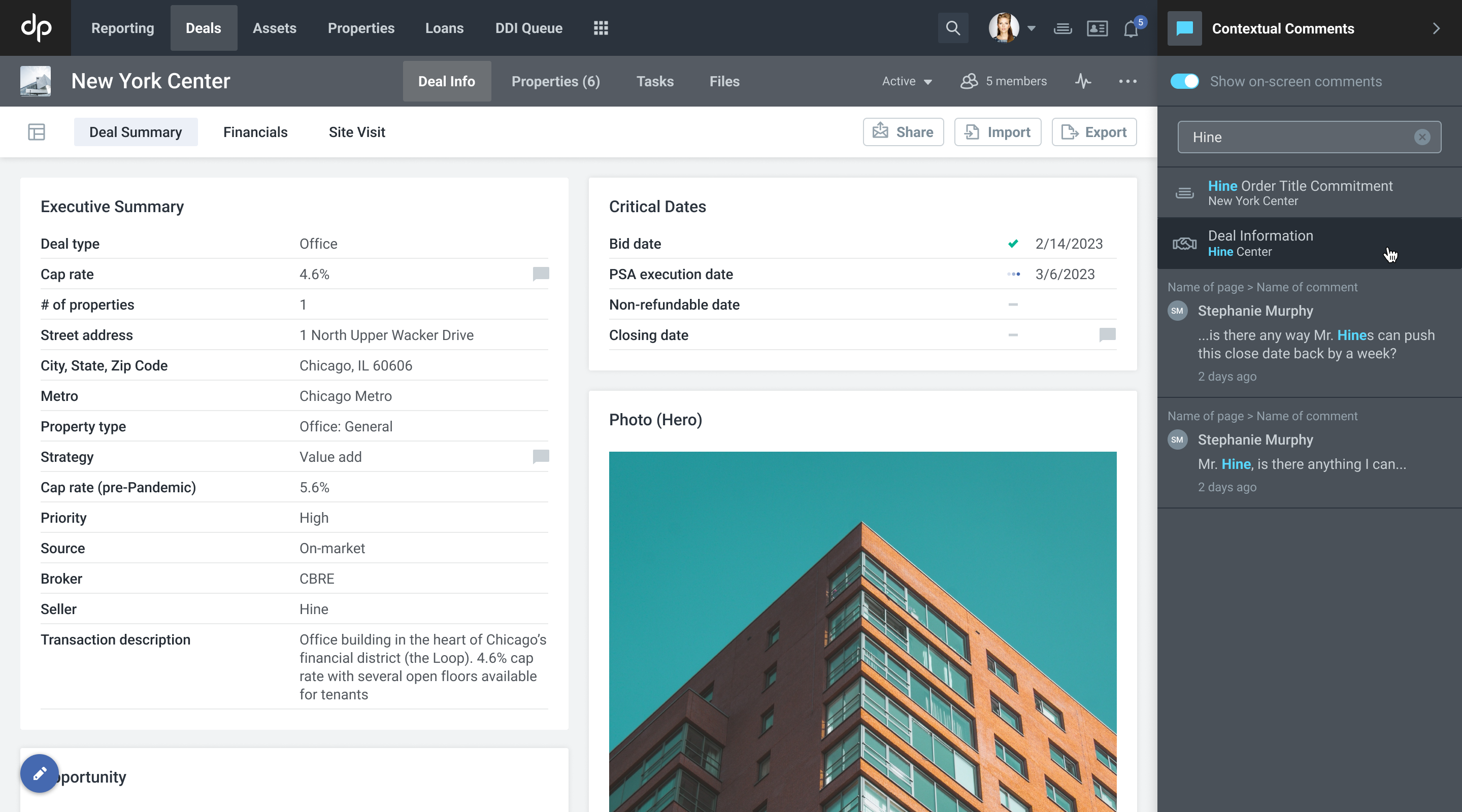
Contextual Comments, shipped March 2024
Core capabilities
- On-screen comments anchored to individual fields, sections, and widgets on info views, plus saved reporting views.
- Collaboration threads, quoted replies, reactions, @mentions of people and groups, rich text, images, and attachments.
- Staying on top of it auto-follow, flag for follow-up, email notifications, and reply-by-email.
- Finding it global and record-level conversation lists, plus search.
- Migration all existing deal comments moved into a deal-level conversation.
Build and launch
Core build in about 10 weeks, staged rollout to every team
- Oct 2023
- Concept, one-week prototype, punch list
- Nov 7, 2023
- Prototype demo with Rausch Coleman Homes
- Oct 17 – Dec 22, 2023
- Core build (Jira epic DP-35482)
- Jan – Feb 2024
- Enhancements: images, attachments, reply-by-email (DP-36439)
- Feb 15, 2024
- Beta: 6 teams
- Mar 19, 2024
- Phase 1: 30 teams
- Mar 21, 2024
- Phase 2: 100 teams
- Mar 26, 2024
- Full release: 125 teams
Holding scope after the PM change was a constant effort, and it didn't always go the way I wanted. At times it was doubtful the feature would ship at all. It did ship, thanks in large part to a close working relationship with Josh.
Impact at launch
About three weeks after full release
What the numbers say
- It created new collaborators Nearly half of Contextual Comments users hadn't posted a task or deal comment in the previous 12 months.
- Context was the point Most comments were anchored to a specific field or section, and 47% @mentioned a teammate.
- Reach beat volume Task comments still outnumbered conversation comments about 3:1, but conversations reached a wider audience.
Real use cases from customers
- Data quality checks: "Add estimated close date." (Nuveen)
- Deal collaboration: "Can you look up the ages of these buildings on CoStar?" (Rising Realty Partners)
- Documenting decisions: "I am approving this, but I have a few concerns…" (Dream Finders Homes)
*Source: Doug Maschoff, Monthly Product Review, April 2024
Impact today
Two and a half years later, it's still how teams talk about data
Monthly averages, Oct 2025 – Sep 2026
| Action | Visitors | Accounts | Events |
|---|---|---|---|
| Open / view an on-screen comment | ~955 | ~193 | ~3,900 |
| Post in Contextual Comments | ~236 | ~100 | ~880 |
| Post a task comment (comparison) | ~289 | ~69 | ~3,050 |
What the numbers say
- The launch pattern held Task comments still lead on volume, but Contextual Comments reaches about 45% more accounts.
- It works as documentation Four times as many people read conversations as write them, which is the visibility value we designed for.
- Watch item monthly posters eased from 291 (Oct 2025) to 195 (Sep 2026); task comments softened over the same period.
*Source: Pendo feature analytics, retrieved Oct 2026
Where we didn't get there
Set aside, not failed
The vision was conversations everywhere: reporting, dashboards, comps, loans, folders, and files. Phase 1 shipped on info views and saved reports and beat its adoption target. Then company priorities shifted to AI features, and the expansion was never picked up.
- Comps and loans conversations were switched off just before launch.
- Contextual Comments on dashboards and reporting widgets (Phase 2) were never scheduled.
- The Contextual Comments backlog epic remains open.
My take
There are still easy wins to make Contextual Comments better. But as Dealpath's AI features mature, I'd expect engagement with comment threads to decline, because more questions will be answered by the system rather than by a colleague. Iterating now wouldn't be the best use of effort until the AI work settles, and that may never happen. Setting it aside was the right call.
Reflection
What I learned
Prototype early to sell the idea
A rough prototype in a week, borrowing patterns people already knew from InVision and Figma, made the concept concrete. It's what let us sell the idea internally and validate it with customers before committing engineering time.
Scope is a design responsibility
Holding scope through a PM change didn't go as smoothly as I'd have liked. But keeping the feature focused is a big part of why it shipped when, at times, that looked doubtful.
Context is the feature
Anchoring conversations to the data is what makes this feature work. At launch, 59% of comments were anchored to a specific field, section, or widget rather than left at the page level. The comment is only as useful as its connection to the thing being discussed.