

My role
Product Designer, concept through launch and beyond
I designed AI Extract from July to mid-October 2023, partnering with Luca Pasquesi (PM), then returned around January 2024 to correct course and kept iterating every few months until Henderson took the product over. After that, I advised him on the Deal Screening experience and helped refine its UI.
- Owned the end-to-end UX: the self-review experience, the submissions list, the drag-and-drop and email entry points, and portfolio review across multiple properties.
- Designed how AI output is shown and verified: a clear marker that a value was AI-extracted, a picker for choosing between multiple candidate values, and links from each value to its location in the source document.
- Ran research with customers and with internal stakeholders in CS and Engineering.
- Corrected course in January 2024 after an engineering-led iteration cluttered the review screen (see Design decisions).
The problem
Deal data was trapped inside PDFs
Every acquisitions team receives a steady stream of offering memorandums (OMs) and broker flyers. Getting that data into Dealpath meant manual entry, so most teams only entered the deals they were actively pursuing, and everything else stayed locked in documents.
Dealpath's answer was DDI (Deal Data Ingestion), a managed service where an offshore team abstracted OMs by hand. It worked, and the customers who used it were stickier, but it couldn't scale.
Pain points
- Slow screening Manual entry got in the way of evaluating every deal that crossed a desk.
- No market database Teams wanted a proprietary database of comps and listings, but didn't have time to build it.
- AI skepticism Firms wanted to use AI but didn't trust its accuracy.
*Source: AI Extract Product Brief, July 2024; AI Extract Enablement Deck, May 2024
The bet
Make data extraction self-serve, free, and trustworthy
Replace the human-run service with AI: drop in an OM (or forward it by email), let the model extract about 45 standard deal and property fields, then let the customer review and create a deal or a comp in minutes. Free for every customer, with the managed service kept as a premium tier.
Business goals
- Retention DDI customers were 61% less likely to be at risk of churn; extend that to everyone.
- Win rate Competitors (Altrio, DealCloud) were marketing AI ingestion; match and beat them at no extra price.
- Platform adoption Pull existing customers onto Properties and standard fields, which future features required.
Success metrics
- Used by 30 teams within 30 days of launch.
- 85% extraction accuracy at launch, 90% by end of Q3 2024.
The key insight
Accuracy beats speed, and users want to be the check
I ran research sessions with customers and with internal stakeholders in CS and Engineering. Together with the broader customer research behind the product brief, it pointed to a clear answer on the most important design question: should AI create deals automatically, or should a person review first?
"Accuracy is very important. It cannot be sacrificed for speed. The consequence of having bad data is high."
"It's better to me say 'I reviewed the information' rather than a 3rd party did."
Human in the loop as a bridge
In 2023, the AI was nascent and we didn't fully trust its accuracy. Neither did our customers, who tend not to be early adopters. So I designed review as a bridge: an easy, fast way for users to confirm or overwrite each value while referencing the source document. It earned trust while the model got better, and carried the product to where it is today, with near-complete accuracy.
Design decisions
Designing for trust in AI output
Each field links to the page(s) where values were found, so users can verify any number in seconds instead of hunting through a 60-page PDF.
When the model found more than one plausible value, users choose the right one rather than accepting a silent guess.
A blue icon marks fields with alternative values, a red warning marks missing required fields. Attention goes only where a human is needed.
The human-in-the-loop bridge: low confidence in early AI, on both sides, meant users needed to own the final values.
Move a listing straight into the pipeline as a deal and properties, save it as comps to build a market database, or skip it.
30% of analyzed OMs were portfolios, so users review each property in turn within one submission.
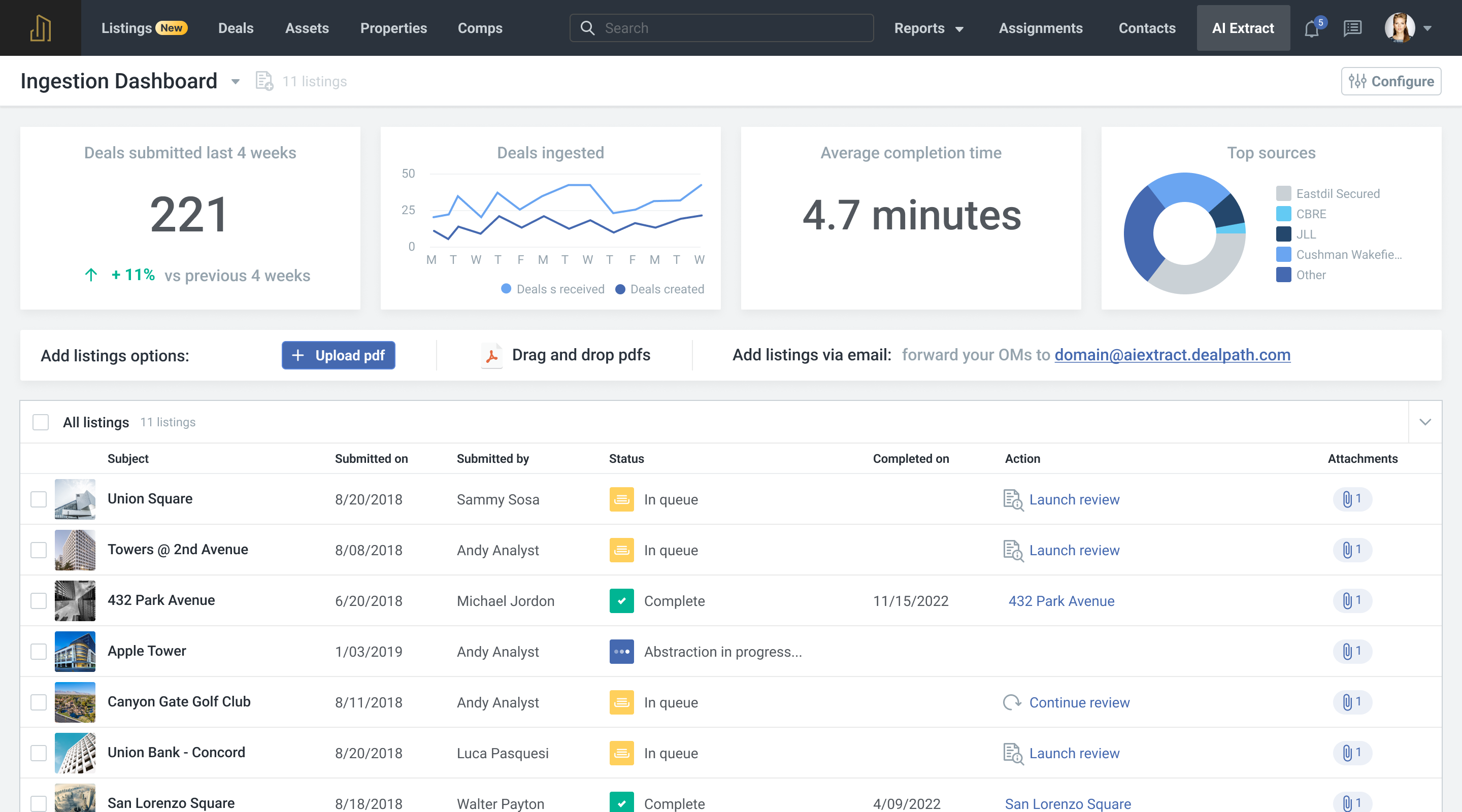
Drag-and-drop or email forward meets OMs where they arrive; the list is home base while extraction runs.
Course correction, January 2024
An engineering-led iteration added a checkmark to every successfully extracted field. On a review screen with dozens of fields, the checks buried the page in noise. I was brought back to redesign it around one principle: call out the problems, not the successes, so reviewers' attention goes straight to the fields that need them.
An experiment we reversed
For sales comps, we tried a matrix that showed every extracted comp at once. In practice it was hard to follow, so we returned to the one-at-a-time pattern already proven for properties.
The solution
AI Extract, generally available June 2024
How it works
- Submit drag a PDF into Dealpath or forward the email to a team-specific AI Extract address.
- Extract AI pulls about 45 standard deal and property fields, typically in about five minutes at launch (15 quoted).
- Review resolve flagged fields, pick between candidate values, and jump to the source page for any value.
- Create turn the listing into a deal with its properties, save it as comps, or ignore it.
Build and launch
From managed service to self-serve AI
- Mar 2023
- DDI Queue productizes the managed service
- Jul – mid-Oct 2023
- Core design (Chad, with Luca Pasquesi); DDI automated abstract & review, phase 1
- Jan 2024
- Chad returns to correct course on the review screen; AI Extract v2.0
- Mar 20, 2024
- Beta
- May 2024
- Renamed from DDI to AI Extract; UX improvement rounds
- Jun 4 – 11, 2024
- Customer rollout (opt-in, free) and marketing launch
- Jun – Oct 2024
- UX Part 2 and sales comps extraction
- Apr 2025
- AIX v2, a major accuracy upgrade (Dennis Su)
- Late May 2026
- AIX Embedded ships (Henderson); Chad advises on Deal Screening UI
Impact at launch
A working product, slow early adoption
What the numbers say
- The core worked Accuracy hit the 85% launch target, and extraction ran three times faster than promised.
- It improved the service too In testing, AI Extract was more accurate than the managed service alone, so the offshore team started using it as a first pass.
- Adoption lagged the goal The 30-teams-in-30-days target was missed. Teams had to request access and already be using Properties and standard fields, which blocked many existing customers.
*Source: AI Extract Product Brief, July 2024; Monthly Product Review, April 2024
The evolution
The foundation held; AIX moved into the deal
The 2024 launch laid the foundation: the extraction engine, the review-and-verify pattern, and the deal and comp creation flow. As the model improved, the next step was to stop making users go to AI Extract and bring it to them.
AIX Embedded lets users drop an OM directly into the context of a deal, from deal creation or the deal screening view. Henderson led it as PM and designer; I advised on the Deal Screening experience and helped refine its UI.
What changed
- In context Extraction lives where deals are created and screened, removing the detour that held back early adoption.
- Far more accurate From 70–75% at beta to 85% at launch to roughly 95% today, now marketed as "95% accuracy out of the box."
- More than OMs AIX handles OMs, flyers, CIMs, and BOVs, extracts embedded sales comps, and added IC memos in 2026. It now reads Excel and Word files as well as PDFs.
- Cheaper to run A model change in 2026 cut the cost per extraction to about a third.
*Source: DivCo West AI Roadmap, Oct 2025; AI/ML Opportunities, Aug 2026; Using AI Extract help article, Sept 2026
Impact today
From slow start to the anchor of Dealpath's AI suite
Accounts creating deals or comps from AI Extract (Pendo)
| Month | Accounts | Visitors | Creates |
|---|---|---|---|
| Oct 2025 | 84 | 496 | |
| Jan 2026 | 81 | 617 | |
| Mar 2026 | 107 | 698 | |
| May 2026 | 87 | 544 | |
| Jul 2026 | 140 | 440 | |
| Sep 2026 | 164 | 584 |
What the numbers say
- Embedding unlocked adoption After AIX Embedded shipped in late May 2026, accounts using AI Extract roughly doubled within two months.
- It became the foundation for everything else AI Extract now underpins Listing Screening, Deal Screening, and the client-facing MCP, and is being priced as a paid product.
- The 2024 roadmap came true Sale comps, debt fields, and new document types all shipped, as the original brief planned.
Note: June 2026 shows a dip in Pendo (36 visitors) that likely reflects re-tagging after the embedded release, not real usage.
*Source: AI/ML Opportunities, August 2026; Pendo feature "AI Extract – Create," retrieved Oct 2026
What I learned from the slow start
The product worked; access was the bottleneck
The 2024 launch hit its quality bar but not its adoption goal. Internal reviews later described it as two years of low adoption. The friction was mostly outside the core review experience:
- It was opt-in: customers had to request access.
- It required Properties and standard fields, which many existing customers didn't use.
- It lived on its own page, separate from where deals were created.
Once it moved into the context of the deal, usage jumped. The lesson: the best AI feature still has to live in the user's existing path, and a solid foundation lets you move it there without rebuilding.
Reflection
What I learned
Human in the loop was the right bridge
When we started, AI was nascent and our customers weren't early adopters. Designing review as a bridge, rather than promising full automation, let them trust the product while the model caught up. In the last six months that has flipped completely: now everything has to be AI. The bridge got us there.
Extend proven patterns before reinventing them
We had a review pattern that worked. Trying a matrix for comps cost a round of iteration before we came back to it.
What I'd add
Better filtering in the submissions list, so users can focus on the listings most relevant to their strategy instead of working through everything in order.