

My role
Senior Product Designer, partnered with Frances Lo (PM)
I designed AI Recommended Comps from fall 2025 through the January–April 2026 build, partnering closely with Frances Lo.
- Integration across views how recommendations sit alongside attached comps in the list, map, and comparison views.
- Review controls attach, dismiss, show more, and the AI sparkle indicator on the Comps tab.
- Freshness and refresh the "last updated" timestamp and manual refresh that made on-demand scoring work for users.
- Customer validation Frances and I took turns presenting to customers, and ran more rounds of validation with customers, CS, and engineering than on any earlier project.
The problem
Finding comps was slow, and comps barely made it into Dealpath
Sale comps are central to underwriting: they tell a team whether an asking price is reasonable. But sourcing them meant hours of searching, filtering, and re-keying data from other tools for every deal in the pipeline.
Inside Dealpath, the comps feature itself struggled. CS identified the main adoption blocker as simply getting comps into the system, from three sources: internal comps, broker-provided comps in OMs, and external providers such as MSCI RCA.
Pain points
- Manual sourcing Every analyst filtered and searched differently, so comp sets were slow to build and inconsistent.
- Empty comps tabs New deals opened to an empty state, with no prompt or head start.
- Underused data Even teams paying for RCA, or with years of internal history, weren't surfacing it at the moment of underwriting.
*Source: Comp enhancements working doc (Frances Lo), 2025–2026; AI Recommended Comps help article, Sept 2026
The bet
Bring the comps to the deal
Instead of making analysts search, surface the most relevant sale comps automatically on every deal and asset, ranked by similarity, drawn from the team's own comps library and, where licensed, MSCI RCA. Users review, attach, or dismiss each one inline.
This tied together recent investments: the RCA integration supplied external comps, and AI Extract was already pulling comps out of OMs. Recommendations put that data to work where decisions are made.
Goals
- Save time on comp sourcing and make comp sets more consistent across analysts.
- Drive comps adoption: the Q2 2026 key result was 24% of ICP clients using Comps.
- Contribute to Dealpath's broader AI adoption goals as part of the 2026 AI suite.
How the recommendations work
Structured similarity, with a human deciding
Same property type; MSCI comps limited to sale transactions; records missing location or type are excluded.
Proximity, recency of sale, size (GLA, units, or land), year built, property subtype, and price, price/SF, or price/unit.
Show matches above about 70%, loosening to about 60% if there are fewer than five; up to five shown per property, more on request.
Attaching or dismissing a comp updates the list for the whole team.
Every attach and dismiss is logged with its match score and inputs, to tune the model over time.
*Source: AI Recommended Comps specification, in Comp enhancements working doc
Design decisions
Making AI suggestions easy to judge and act on
Users always know what's a suggestion and what's part of the deal.
Gives users the "why" behind each suggestion so they can trust or reject it quickly.
No modal, no context switch; comp sets come together in a few clicks.
The same review pattern everywhere, adapted to each surface.
Tells users new recommendations are waiting, without being intrusive.
Turns the empty state into a starting point.
Made on-demand scoring feel fresh and controllable (see next section).
Portfolio deals made it unclear which property a comp set belonged to.
An approach that didn't fit: recommendations on the map
Recommendations didn't work well layered onto the map itself. Instead, the map sidebar uses tabs to separate attached comps from recommended ones, each shown as cards, and the list view stays the primary place to review recommendations.
Designing around a compute constraint
When the ideal UX was too expensive to run
Engineering flagged that rescoring every comp against every property daily would be extremely heavy, comparable to an existing job that could take days. The options were scheduled rescoring for everyone (best UX, highest infrastructure risk) or on-demand scoring (efficient, but at risk of an empty or laggy first experience).
Engineering proposed a first-pass solution. Frances and I refined it into something that worked for users:
- Recommendations generate when a property is created or attached, and when a deal or asset is opened for the first time.
- A "last updated" timestamp makes freshness visible, so users aren't left wondering.
- A manual refresh, with a daily limit, puts users in control without runaway cost.
The solution
AI Recommended Comps, spring 2026
Interactive prototype: AI Recommended Comps prototype
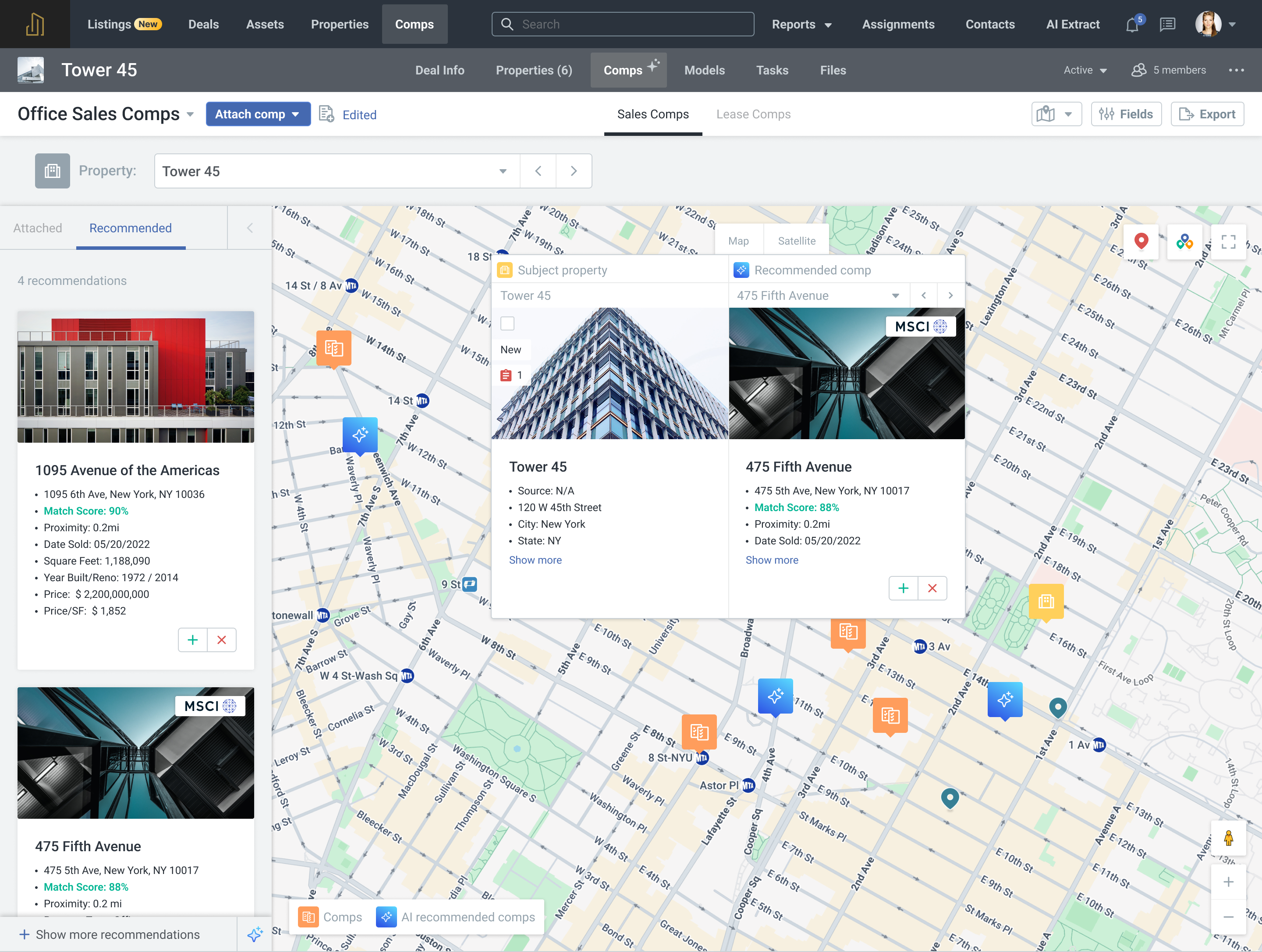
Where it shows up
- The Comps tab on every deal and asset, across list, map, and comparison views.
- Sources: the team's own comps library (including comps from AI Extract) and MSCI RCA, for licensed teams.
Build and launch
From spec to the 2026 AI suite
- Aug 2025
- Epic and stories written (DP-45088)
- Fall 2025
- Design and customer validation (Chad, with Frances Lo)
- Late 2025
- Engineering review; scoring approach reassessed for compute cost
- Jan – Mar 2026
- Build: list view, attach/dismiss, on-demand scoring, manual refresh, map and comparison views
- Feb 2026
- Internal test environment and bug bash
- Apr 2026
- MVP release
- May 2026
- Scoring improvements and map pins
- Jun 2026
- Part of the AI Suite spring launch at Realcomm
Impact so far
A strong comps quarter, early and narrow recommendation usage
Recommendation actions by month (Pendo)
| Month | Accounts attaching | Attaches | Dismisses |
|---|---|---|---|
| Apr 2026 | 70 | 26 | |
| May 2026 | 121 | 16 | |
| Jun 2026 | 122 | 34 | |
| Jul 2026 | 75 | 27 | |
| Aug 2026 | 44 | 120 | |
| Sep 2026 | 38 | 45 |
What the numbers say
- Comps adoption beat its goal 29% of ICP clients used Comps in Q2, against a 24% target, with recommendations as part of the push.
- When users act, they mostly keep the suggestions About two-thirds of recommendation actions through September were attaches.
- Reach is still narrow About a dozen accounts use recommendations in a given month; AI Extract still accounts for 92% of AI usage.
- Dismisses are signal, not failure Dismisses overtook attaches in August. That's expected: no recommendation set will be a perfect match, and every attach and dismiss is logged with its match score to refine what users are looking for.
*Source: AI/ML Opportunities, Aug 2026; Pendo features "Sale Comps – Attach/Dismiss recommendation," retrieved Oct 2026
What's next
The open question: should a deal also be a comp?
During validation, the question we heard over and over was: why can't I just compare a deal or property without converting it to a comp first? Teams have years of vetted deal history in Dealpath, but none of it surfaces as a comp unless someone converts it by hand. That feedback is shaping the next phase, which brings a team's own deals and properties into comp recommendations.
- Recommend deal properties as comps, converted automatically on attach (DP-46202).
- Prompt to create a comp when a deal closes, with default field allocation.
- Comps in reporting, and viewing comps by property.
Reflection
What I learned
Customers as design partners
Compared to earlier projects, Frances and I ran far more validation loops with customers, CS, and engineering. By then, our customer relationships had matured to where customers actively shaped the feature, and the strongest idea for what comes next came straight from those conversations.
Know when a pattern doesn't fit the surface
Recommendations worked in the list but not on the map. Adapting the pattern, with tabs and cards in the map sidebar, served users better than forcing consistency.
Design for imperfect AI
Recommendations will never be a perfect match every time. Making dismiss as easy as attach, and capturing both, turns every "no" into data that improves the next recommendation.